
Energy prices are high. This is what to do about it.
Close-up of a digital stock market trading dashboard displaying real-time financial data, candlestick charts, price trends, and market performance indicators. The screen features rising and falling stock prices, investment analytics, and trading metrics in USD, representing stock trading, financial markets, investment strategy, and market volatility.
A practical guide to hedging — and why the current market makes the case better than ever.
If your energy bill has felt heavier lately, you're not imagining it. Wholesale electricity and natural gas prices have climbed significantly, and the conditions driving those increases: supply tightness, geopolitical pressures, and grid constraints, show no signs of resolving quickly. For businesses, that creates a familiar and uncomfortable tension: do you act now, or wait and hope the market softens?
This is exactly the environment where having an energy strategy matters most. And that strategy has a name: hedging.
Where the market stands today
Recent wholesale market volatility in the Middle East and broader eastern energy markets is beginning to impact New England pricing. Massachusetts utilities have already filed for 14–16% electric rate increases effective August 1, an early signal that higher costs are starting to move through the region.
Historically, pricing shifts in neighboring markets don’t stay isolated for long. As suppliers adjust to changing wholesale conditions, we expect this pressure to continue spreading across New England, creating a more expensive procurement environment heading into November and December renewal season.
What hedging actually means
Hedging is a risk management strategy, not a prediction. When a business hedges its energy costs, it secures pricing on a portion of its future usage in advance, trading some upside potential (if prices fall) for meaningful downside protection (if prices rise further).
The goal is not to outguess the market. The goal is to stop being fully exposed to it.Think of it the way a business thinks about insurance: you don't buy fire insurance because you expect your building to burn down. You buy it because the cost of being wrong — without coverage — is unacceptable.
Why prices move the way they do
Energy markets are influenced by an unusually wide range of variables: weather, natural gas production levels, seasonal demand patterns, global supply chains, grid reliability, and government policy — to name only the most common. The result is a market that can look stable for months and then shift sharply with little warning. For businesses running on annual budgets, that volatility is a structural problem, not just an inconvenience.
Three approaches worth knowing
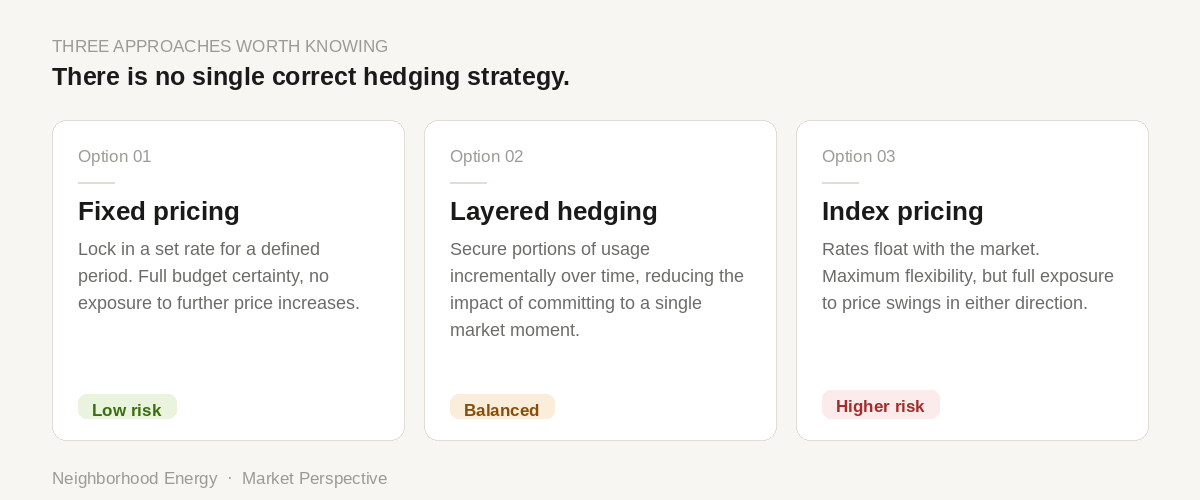
There is no single correct hedging strategy. The right approach depends on your risk tolerance, contract flexibility, and how much budget certainty your business requires.
In the current environment — with prices already elevated — index pricing carries meaningful downside risk. Layered and fixed approaches offer progressively more protection, though fixed pricing in a high market locks in costs that may not reflect better pricing down the road. That tradeoff is precisely why strategy matters: there is no universally correct answer, only answers that are correct for a given business at a given moment.
The case for acting deliberately right now
High markets create a particular kind of pressure on energy buyers. The temptation is to wait — to hold off on any commitment in hopes that prices correct before the next renewal. That instinct is understandable, but it carries its own risk: if prices climb further while you're waiting, your position deteriorates with each passing month.
The alternative isn't necessarily to lock everything in at today's rates. It's to build a structured plan — one that addresses your current exposure, defines your risk limits, and gives you a rational basis for decisions rather than forcing you to react under pressure at renewal time.
What a good energy advisor actually does
Energy markets move quickly, and following them closely while also running a business is genuinely difficult. A strong advisor doesn't just present contract options — they help you understand your exposure, evaluate your risk tolerance honestly, and build a purchasing strategy aligned with your actual business goals. That includes knowing when waiting is the right call, not just when buying is.
If you're navigating a renewal in this environment and haven't had that conversation yet, now is the right time to start.
Questions about your current exposure? We're here to help you think it through.