
New England pays more for energy in January than almost anywhere else in the country. Not because the gas costs more to produce, and not because the region uses more of it. It pays more because the pipe is full.
That single fact drives nearly every seasonal pattern in New England energy pricing — and it drives your electric rate as much as your gas rate. It also explains why the weeks between mid-August and late October matter so much to anyone buying energy here. This is the shoulder season, and it is the only stretch of the year when the region's structural disadvantage briefly stops showing up in the price.
The pipeline math behind New England's winter premium
Two interstate pipelines carry the bulk of the region's gas: Algonquin Gas Transmission, running east through Connecticut and Rhode Island into the Boston area, and Tennessee Gas Pipeline, entering from the west and north. Their capacity is fixed. Regional demand is not.
When utilization on the Algonquin system climbs past roughly 85 to 90 percent, the constraint binds and the delivered price at Algonquin Citygate — the trading point serving the Boston market — separates sharply from the national benchmark. That gap is called basis: the locational premium a buyer pays to get gas to a specific delivery point.
Two units of measure appear throughout this piece. Wholesale gas trades in MMBtu (one million British thermal units). Your gas bill is denominated in therms. One MMBtu equals roughly ten therms, so wholesale gas at $18/MMBtu is about $1.80 per therm before delivery, taxes, or margin — a useful number to hold against whatever your current supply contract says.
In an unconstrained market, basis is a rounding error. In a constrained one, it becomes the entire story.
Summer and winter are two different markets on the same pipe
Pipeline capacity is sold two ways. Firm capacity is reserved and guaranteed; interruptible capacity is whatever is left over on any given day. Local gas distribution companies hold firm capacity to serve heating load and have first call on it. Power generators largely buy what remains.
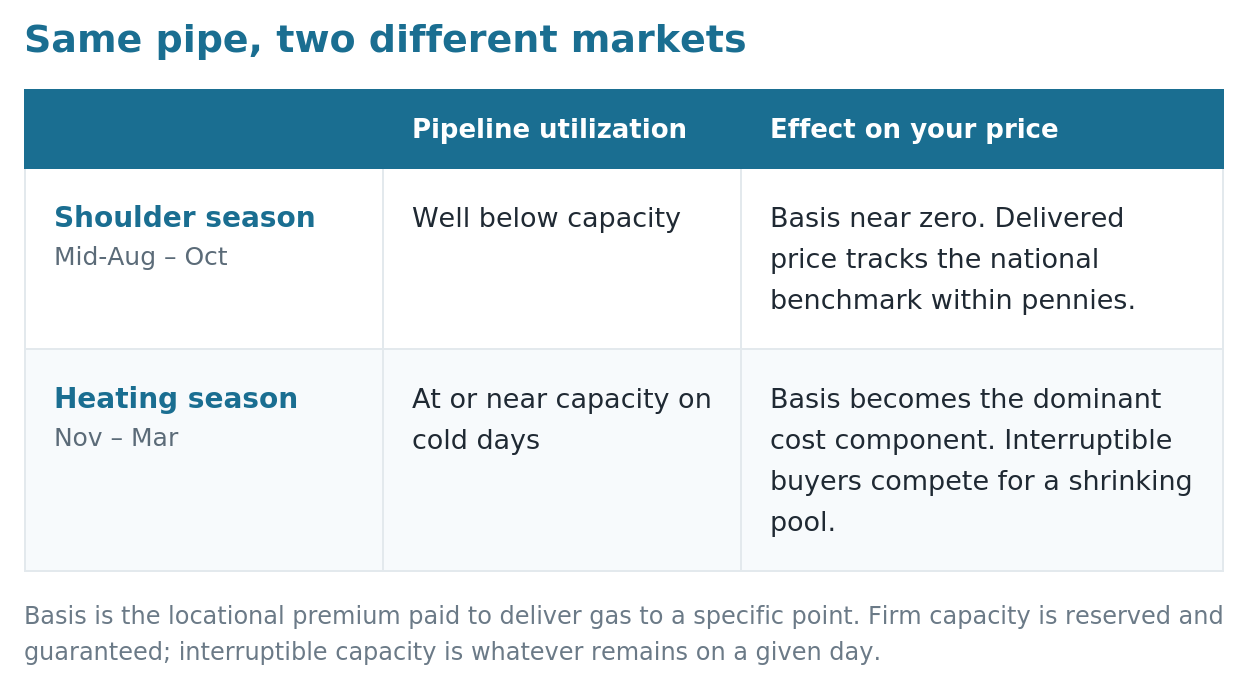
On the coldest days there is very little left over, and the price of that residual gas is set by whoever needs it most. The scale of the resulting move is not theoretical. During Winter Storm Fern in late January 2026, spot gas at Algonquin Citygate reached $122.575/MMBtu on January 26. Regional points went with it — PNGTS to $73.335, Maritimes & Northeast to $90.360.
At those levels the generation stack reorders itself. Fuel oil at roughly $3.50 per gallon converts to about $25/MMBtu, so once Algonquin spot ran above $35, oil-fired units became cheaper to run and ISO New England dispatched them ahead of gas plants buying on the spot market. That is what a fully constrained pipeline looks like from the inside: a regional grid burning oil in 2026 because gas physically could not get here.
Why this shows up on your electric bill too
This is the part that surprises most property managers. Pipeline constraints are a gas story that determines the price of electricity.
ISO New England dispatches generation in order of cost, and on most hours of most days the last unit called — the one that sets the clearing price for everyone — is a natural gas plant. When that plant's fuel costs four times more in January than in September, the regional power price follows. Winter basis doesn't stay in the gas market. It passes straight through to the kilowatt-hour.
You can see it in the utilities' own filed schedules. Demand-metered commercial classes are priced monthly, so the seasonal shape is visible rather than blended away:
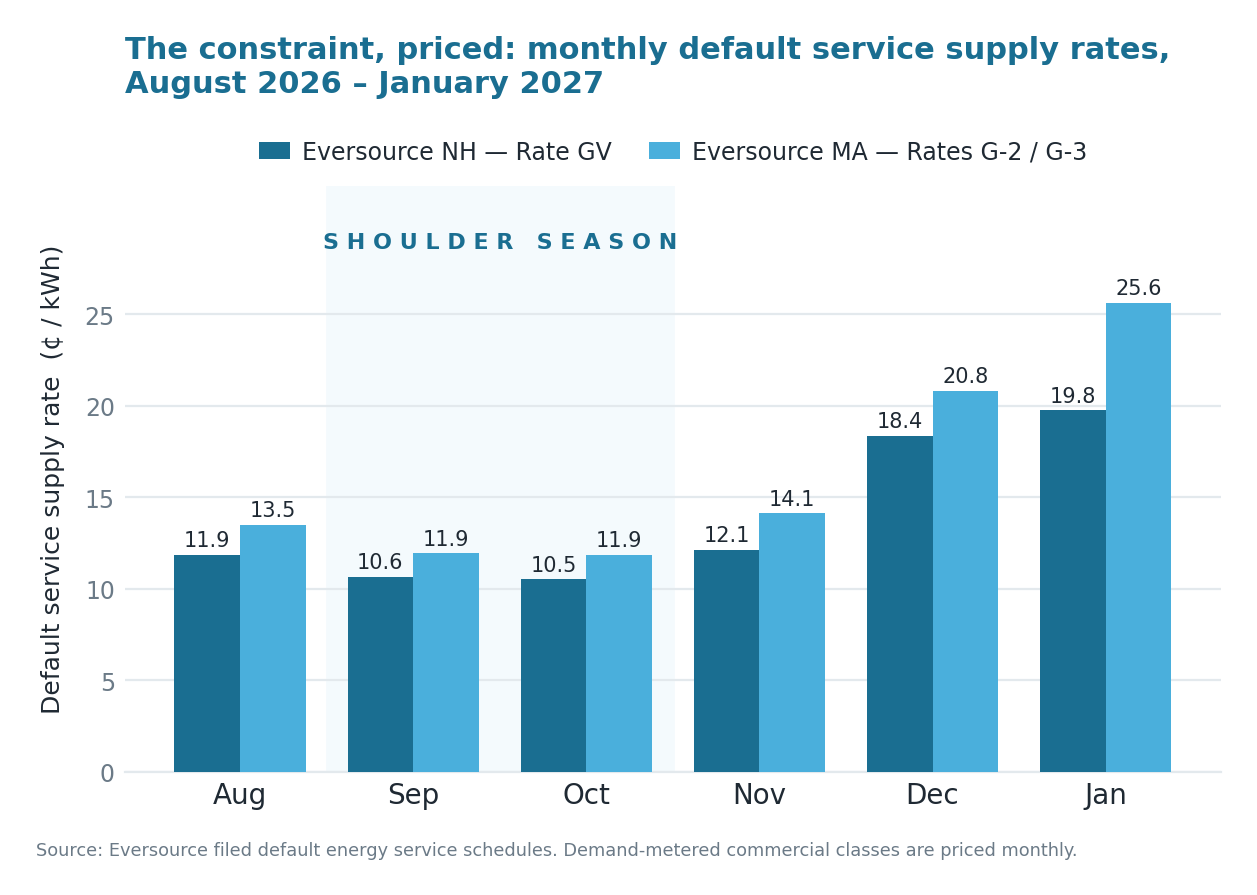
Eversource New Hampshire's Rate GV default runs 10.645¢/kWh in September and 19.760¢ in January — an 86% climb. In Massachusetts, Eversource's G-2 and G-3 classes run 11.933¢ to 25.636¢ over the same months, a 115% climb. Both schedules are already filed. Neither is a forecast.
For a property drawing 100,000 kWh a month on New Hampshire default service, that is roughly $10,645 in September and $19,760 in January. The same building, the same usage, about $9,100 more in a single month — driven by a pipeline constraint several hundred miles away.
What winter 2026–27 is already priced at, and why September matters
A forward curve is the set of prices at which future months are trading today; a strip is a block of those months bought together. Both are how suppliers build a fixed-rate quote.
As of the first trading days of August 2026, December-through-February gas at Algonquin Citygate was trading above $18/MMBtu — roughly $1.80 per therm. That is not a projection. It is a price at which counterparties are transacting.
It has also moved considerably through the year. The 2026/27 winter strip peaked near $14.16 in late March, eased to $12.85 in early April, and traded near $11.59 by late June before firming again. Timing within the shoulder window matters, which is why a rate captured in a soft week is worth more than a plan to watch the market.
Here is how that reaches your contract. When a supplier prices a 12-month fixed rate, they are pricing a strip of forward months and hedging the basis risk in each one. A contract quoted during the shoulder season is built off a curve where the near months carry almost no locational premium. A contract quoted in November or December is built off a curve where the very next months carry the highest basis of the year — and that cost is embedded in the rate you sign.
The shoulder season does not land on the same date every year. It opens when cooling demand fades and closes when heating demand takes hold; this year it opened in mid-August. It typically runs eight to nine weeks.
No new capacity arrives before this winter
It is reasonable to ask whether any of this is about to change. The short answer is not soon.
Enbridge has proposed Project Beacon, an expansion of the Algonquin system of roughly 300 MMcf/d — about 10 percent of capacity. A binding open season ran from May 18 to July 1, 2026. If it proceeds, Enbridge expects an in-service date around November 2030. A smaller, separately contracted AGT Enhancement project, with Eversource among its committed customers, is expected to see construction in 2028 pending federal approval. Constellation's Everett Marine Terminal, which can deliver up to 435 MMcf/d into regional pipelines, remains a load-bearing piece of winter reliability, with supporting utility contracts running to roughly mid-2030.
Whatever relief eventually arrives, it does not arrive for this winter, next winter, or the two after that. The constraint is structural across any planning horizon that matters to a contract signed today.
A note on heating oil
Heating oil deserves a brief mention this year, because the usual fallback is unusually expensive.
Front-month heating oil traded around $4.45 per gallon on September 1, 2026, up roughly 15 percent over the prior month, with Massachusetts retail medians elevated across all twelve counties and a statewide median near $4.72 per gallon. Fixed-price and prepay programs for the 2026–27 season are thin and expensive, and in many cases unattractive at current levels.
Dual-fuel facilities that historically leaned on oil as a hedge against winter gas spikes have a weaker hedge this year than usual — an argument for locking supply rather than assuming the oil side will cover the exposure. (Note that the EIA pauses its weekly heating oil series April through September; current figures come from retail and futures sources.)
What this means for your accounts
If you are on utility default service or an index rate, you are exposed to the winter premium directly, with no mechanism to opt out mid-season. Look again at the chart above — that is your rate, already filed.
If you have a contract expiring between now and year-end, the month in which you shop determines which curve you are priced against. A December expiration gets quoted off a winter strip. The same meter shopped in September does not.
If you operate dual-fuel equipment, run the numbers on the oil side before assuming it functions as a hedge this season.
The window is open now. It closes when the heating season starts, and it does not reopen until spring.
Frequently asked questions
What is the shoulder season in energy markets? The transitional period between peak cooling demand and peak heating demand — roughly mid-August through October in New England, though the exact dates shift each year. Regional gas demand bottoms out, pipeline constraints ease, and supply pricing typically reaches its annual low.
Why is energy more expensive in New England? Because pipeline capacity into the region is limited and fixed. When winter demand exceeds what the pipes can deliver, the price of the remaining gas rises sharply. That premium is called basis, and because gas-fired plants usually set the regional power price, it raises electricity costs as well as heating costs.
What is an MMBtu, and how does it compare to a therm? An MMBtu is one million British thermal units, the unit wholesale gas trades in. One MMBtu is roughly ten therms, the unit on your gas bill. Wholesale gas at $18/MMBtu is about $1.80 per therm before delivery, taxes, and margin.
Why do pipeline constraints affect electricity prices? ISO New England dispatches generation in order of cost, and the last unit called usually sets the price for the whole market. That unit is typically gas-fired, so when regional gas prices spike in winter, wholesale power prices spike with them.
When is the best time to sign an energy contract in New England? Generally during the shoulder season, before winter basis is priced into the forward curve. Once the heating season begins, every fixed quote incorporates the region's peak-month premium.
Will new pipeline capacity fix this? Not on any near-term timeline. Project Beacon targets an in-service date around November 2030, and the smaller AGT Enhancement project is slated for construction in 2028. Neither affects pricing for the coming winter.
Neighborhood Energy provides competitive electricity and natural gas procurement for commercial property managers, school districts, municipalities, and charter schools across New England. If you have accounts on default service or contracts coming to term this year, contact us for a review before the heating season begins.