
On November 1, New England utilities switched natural gas customers to winter supply pricing, the largest step-change in most commercial bills all year. It brings the same question every November: lock in a fixed price now, or ride the utility rate through the winter?
This year, the answer depends on where your buildings are. In parts of Massachusetts and Maine, a fixed agreement removes real budget risk. In much of Connecticut and parts of New Hampshire, the utility rate is competitive enough that staying put may be the better call. Here is how we read the November 1 rates, and how we decide what to recommend.
The utility rate is a forecast, not a price
A utility's winter supply rate is a regulator-approved estimate of what gas will cost over the season. The utility makes no profit on the gas, but it does not absorb the risk either. If the winter runs cold or prices spike, the rate is revised mid-season, and any remaining shortfall carries forward, with interest, into future rates.
Last winter showed what that means. After Winter Storm Fern pushed Northeast spot gas above $100/MMBtu in late January:
• National Grid's Massachusetts supply rate rose 29% on March 1, from $0.9564 to $1.2329 per therm. Eversource's NSTAR Gas moved almost identically.
• Liberty in New Hampshire went from 91.62 cents per therm in November to $1.1453 in February and $1.75 in March, after initially requesting $2.57.
A business that budgeted on the November 1 rate was off by 30% to 90% on supply cost by spring, through no decision of its own.
Where the market stands now
This winter looks calmer, but New England remains its own market. NOAA favors a warmer-than-normal winter driven by a strong El Niño, and Henry Hub's winter strip traded near $3.40/MMBtu in late October. Algonquin Citygate, the Boston-area benchmark, traded near $11.67/MMBtu for the same winter, with January 2027 above $20. The gap reflects pipeline constraints: on the coldest days, the region still cannot bring in enough gas. Winter forwards fell sharply in early November, which improves fixed pricing signed now, but the exposure to a cold snap remains.
State by state: what changed on November 1
Massachusetts. Regulators approved winter rates on October 30 that hold National Grid bills essentially flat, cut Eversource's EGMA territory by about 5%, and raise NSTAR Gas by about 7%. Commercial supply rates range from $0.7868 per therm at Unitil's Fitchburg Gas & Electric to $1.3570 at Liberty Utilities, with National Grid (Boston Gas) at $0.9809, Eversource at $0.9447, NSTAR Gas at $0.8644 and Berkshire Gas at $1.0048. Flat with last year means starting near the level that needed a 29% mid-winter correction. Separately, National Grid's $342 million distribution rate request, due for a decision by November 30, could raise bills up to 11% early next year. That lands on delivery charges, which every customer pays regardless of supplier.
New Hampshire. Liberty's commercial cost of gas is $0.8330 per therm, while Northern Utilities (Unitil) is $0.6309. Liberty has also proposed temporary distribution increases tied to its pending rate case.
Maine. Northern Utilities (Unitil) sets seasonal rates; its winter commercial rate is $0.6428 per therm. Maine Natural Gas and Bangor Gas adjust monthly against market prices, so customers on default service feel winter volatility in real time.
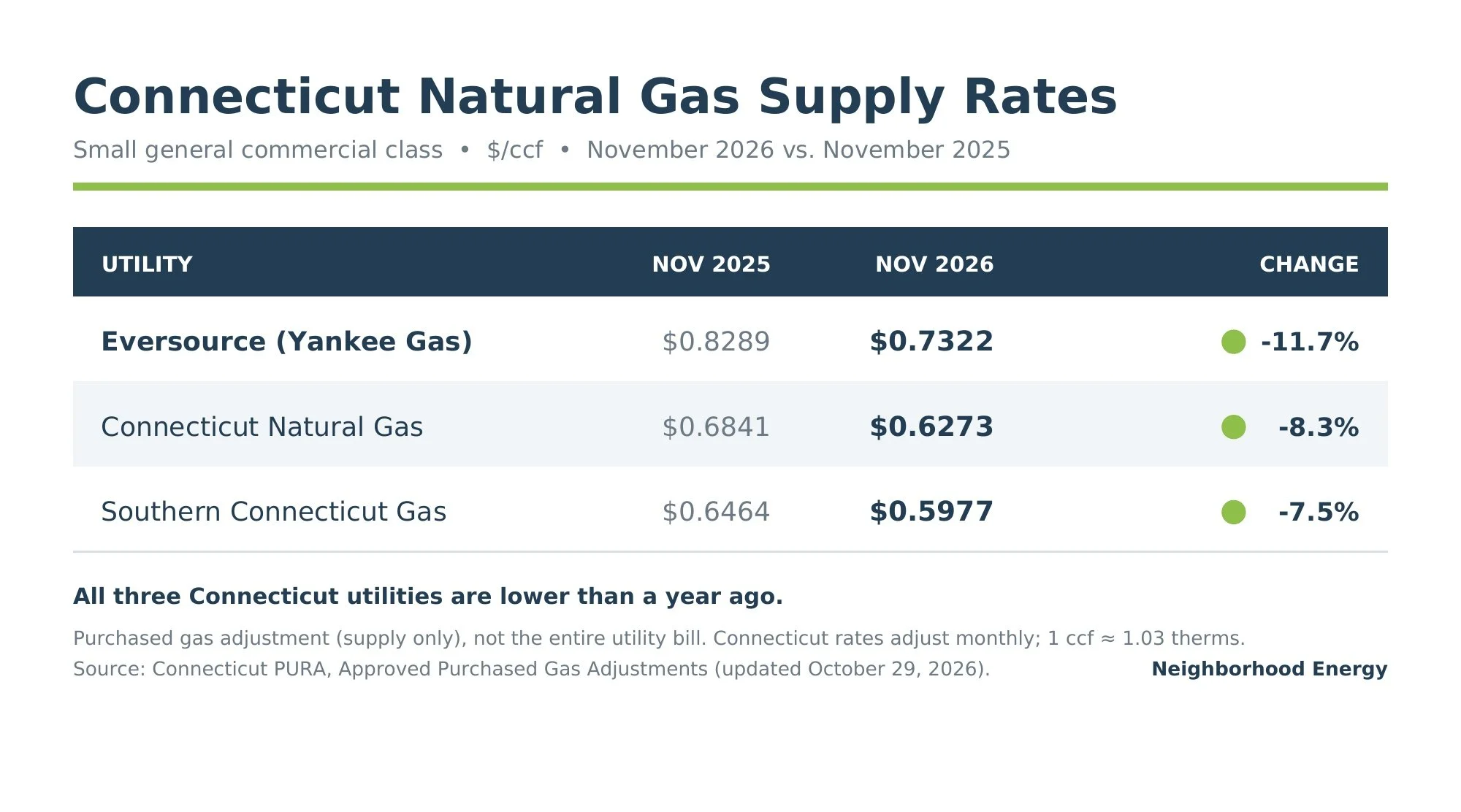
Connecticut. PURA sets purchased gas adjustments monthly, and November rates for small commercial accounts are down at all three utilities:
Why a fixed agreement can make sense in Massachusetts
The case is less about beating the November 1 rate on day one than about what that rate does not guarantee. Default service passes through every mid-winter revision and every prior-year shortfall. A fixed agreement replaces that open-ended exposure with a known number for the term.
That trade is worth the most where a 29% swing in supply cost would force a budget amendment: school districts, municipalities, and property managers who set budgets or common charges a year ahead. Liberty's Massachusetts customers, at $1.3570 per therm, have the strongest case in the region for pricing a fixed agreement now.
Why staying on utility supply can be the better choice
Utilities buy gas through long-term contracts, storage and pipeline capacity held for the whole system. In some territories, that produces winter rates that a supplier pricing off today's $11 to $12 Algonquin strip, before its own costs and margin, struggles to beat.
That is the case in much of Connecticut, where rates are down 7% to 12% from a year ago, and in Unitil's New Hampshire and Maine territories. There, we often recommend staying on utility supply, monitoring it, and revisiting in spring, when next winter's pricing can be compared without a heating season bearing down.
The 12-month agreement: certainty without overcommitting
Where a fixed price makes sense, we generally favor a 12-month term over a multi-year one this year:
It covers the risk that matters. One full heating season, where nearly all the volatility sits, is fixed.
It blends in the cheaper months. The price averages winter and summer usage rather than only the most expensive months.
It keeps the next decision open. A longer term locks today's winter premium into future winters that may price differently.
Where the contract allows, we also aim for a renewal in spring or summer, when there is time to compare offers, rather than in October with winter weeks away.
Sometimes the right recommendation is no contract
An independent broker is paid to find the best outcome for the customer, and sometimes that means leaving things as they are. If the utility rate is likely to beat the market, a supply agreement only adds cost, and we would rather tell you so. In every case, we compare your current agreement and utility rate against live supplier pricing for your usage, and show you the numbers either way.
Request a complimentary review
If you manage natural gas accounts in New England, reply to this post or contact us for a no-cost review of your agreements and utility rates. We will tell you where a fixed price makes sense this winter, and where it does not.
Neighborhood Energy — Securing the Lowest Energy Rates